
Budget was a mild disappointment. Yet, the bull run continues.

The government of India had budgeted to bring down fiscal deficit to 4.8 per cent of GDP in the current financial year, from 4.9 per cent in 2012-13.

With economic growth slowing to a six-year low, IMF Chief Economist Gita Gopinath says the government should undertake structural reforms such as bank clean-up and labour reforms to address the slowdown in domestic demand. She rooted for government policies focusing on managing a slowdown in domestic demand, and on boosting productivity growth and supporting employment creation in the medium term.

Opposition leader Narendra Modi's message of growth and investment is gaining ground.

India's wheat exports could touch a new record of 10 million tonnes in 2022-23, up from a record seven million tonnes in the current financial year, if global market conditions remain choppy and no curbs are imposed on outbound shipments. That is the bullish estimate by officials from global trading firms and market watchers who say the Russia-Ukraine crisis has not only attracted global buyers to India but also pushed the price of Indian wheat from around $320 per tonne (FOB) to over $360 per tonne in less than 10 days. Food secretary Sudhanshu Pandey told reporters that wheat exports till February-end have already reached 6.6 million tonnes and by the end of March, outbound shipments will reach seven million tonnes.
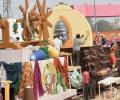
Team Amazon would also educate and train the khadi artisans to directly sell their products to online customers.
United Nations chief Ban Ki-Moon on Monday said the presence of one billion hungry people in the world was unacceptable and noted that farmers are the 'heart and soul' of food security and poverty reduction.Speaking at the World Food Summit that kicked off today at Rome, Ban said, "They (farmers) need seeds and extension services. They need secure water supplies, they need better market access and fairer trade. We must resist protectionism."
For the first eight months of the current financial year, the figure stood at Rs 7.17 trillion.

Sanjeev Nayyar visits an Amma canteen in Chennai, and comes back impressed
The windfall from RBI may be used to trim borrowing, help fund Rs 3.3 lakh crore capex plan, capitalise banks and provide fiscal stimulus to some stressed sectors, experts and economists said.

Prime Minister Narendra Modi on Friday said production linked incentive (PLI) scheme, which is aimed at boosting domestic manufacturing and exports, is expected to increase the country's production by $520 billion in the next five years. Addressing a webinar on PLI scheme, organised by Department of Industry and International Trade (DPIIT) and NITI Aayog, through video conference, Modi said the government is continuously carrying out reforms to boost domestic manufacturing. In this year's Budget, about Rs 2 lakh crore was earmarked for the PLI scheme for the next five years and "there is an expectation that the scheme would result in increasing the production by about $520 billion in the next five years", he said. He added that there is also an expectation that the current workforce in the sectors, which will avail the benefits of the PLI scheme, will be doubled and job creation will also increase.

The Economic Survey states that the rationalisation and reprioritisation of subsidies through better targeting would play a vital role in fiscal consolidation and in targeting expenditure more towards inclusive development.

Economy to grow by 7.2-7.5 per cent in second half of current fiscal, says FM.

While she primed up spending on infrastructure to create jobs and boost economic activity, Sitharaman did not tinker with income tax slabs or tax rates. Her Budget for the fiscal year beginning April 2022 proposed a massive 35 per cent jump in capital expenditure to Rs 7.5 lakh crore, coupled with rationalisation of customs duty, an extension of time for setting up new manufacturing companies and plans for starting a digital currency and tax crypto assets.

PDS: Smart ration cards need to be smarter
The government will roll out its ambitious scheme of transferring cash to beneficiaries of select schemes in 20 districts on Tuesday, but food, fertiliser and fuel subsidies will not be covered in the initial phase.

States are now gearing up to implement the scheme, integrating it with their own public health insurance plans and tying up the loose ends.

The government is scrambling to contain the fiscal deficit at 4.1 per cent of GDP in the fiscal year ending March
The minister, at a packed press conference, made it clear that New Delhi was not prepared for any compromise on the food security issue, adding the deal at Bali has to be fair and balanced as 'it is better to have no agreement than a bad Agreement'.
Government's direct cash transfer scheme is "anti-poor" as it would actually cut subsidies due to the high inflation rate and not cover the rising prices of foodgrains, the Communist Party of India-Marxist on Wednesday said opposing the move.
Railways' freight loading traffic has been scaled down by 100 million tonnes from 1025 million tonnes because of economic slowdown, the minster said.

There are several welcome standalone reforms, but these do not add up to a coherent strategy to achieve a $5 trillion economy or secure Aatmanirbharta, observes Rathin Roy.

The state is following surveillance, containment, increasing testing facilities, and ensuring essentials at people's doorstep, among other strategies, reports T E Narasimhan.
The government on Thursday decided to ask the 13th Finance Commission to map the road for achieving fiscal deficit targets by including off-budget subsidies like oil, food and fertiliser bonds estimated at over Rs 100,000 crore (Rs 1,000 billion) in the Budget.

Finance Minister Arun Jaitley presents his maiden budget next month and faces headwinds from a weak economy, a food inflation scare and now the risk that higher oil prices could swell the government's oil subsidy bill.

The Supreme Court on Monday came down heavily on certain states for not implementing welfare legislation National Food Security Act, saying that why a state like Gujarat was not implementing the law passed by Parliament.
.jpg)
Says high inflation has to be reversed to achieve sustainable GDP expansion.

Prices of milk and derivatives such as cheese, butter, curd and skimmed milk powder were subdued for two years, on a supply surplus.
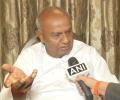
With the family patriarch ageing, his successor H D Kumaraswamy not keeping well, and palpable anger against his other son H D Revanna in the family pocket borough of Holenarsipura, the clan is seemingly in decline.

The seventh round of talks between protesting unions and three central ministers ended inconclusively on Monday as the farmer leaders insisted on the repeal of the three contentious farm laws right from the beginning, even as the government listed various benefits from the Acts.
.jpg)
The CPI(M) on Thursday slammed the Planning Commission estimates on poverty levels in the country, saying these made "a mockery of life and death struggles" of the people, amidst continuous rise in prices and "massive" slashing of subsidies for the poor.

No longer Bengal's finance minister, Amit Mitra, Mamata's principal chief advisor, will still advise and aid the 'chief minister and finance department on all matters relating to management of state finance', represent the 'state government in national and international events/meetings/committees' and examine 'important proposals/files and policy issues relating to financial matters referred to him for advice/views'.

The challenges before the coming Budget are more daunting than those in 2021, reveals A K Bhattacharya.

Steps taken by the government over the past few months signal a determined effort to reform the subsidy regime.

During his address after flagging off the train via video-conferencing, Modi said his government's policies are clear and intentions transparent in reforming the agriculture sector.

The deadline of March 31 has been postponed till the apex court delivers its final judgment.

Three million tonnes of buffer stock, where the government bears the interest and insurance cost, was announced by the Centre only for a year and that period is ending in June.

The upcoming general elections will be the focus and the economy and market performance will pivot around that event. The general consensus is that the India stock market should be up around 10 per cent by the end of the year.
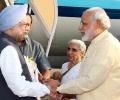
If the PM wishes to be re-elected in 2019, there are a few things he needs to learn from his predecessor
